Enlarge image i
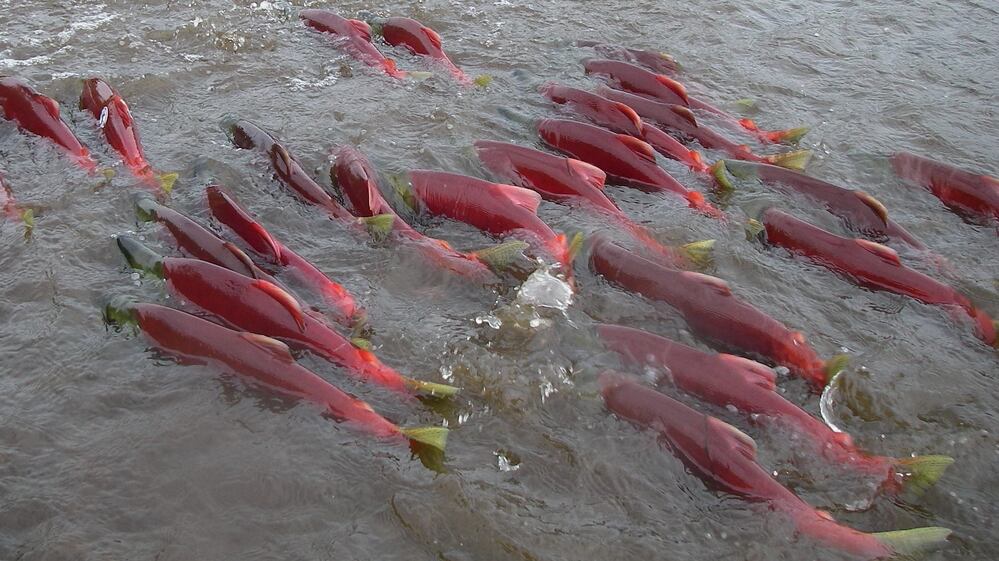
 These sockeye salmon were raised at a land-based fish farm in Langley, British Columbia.
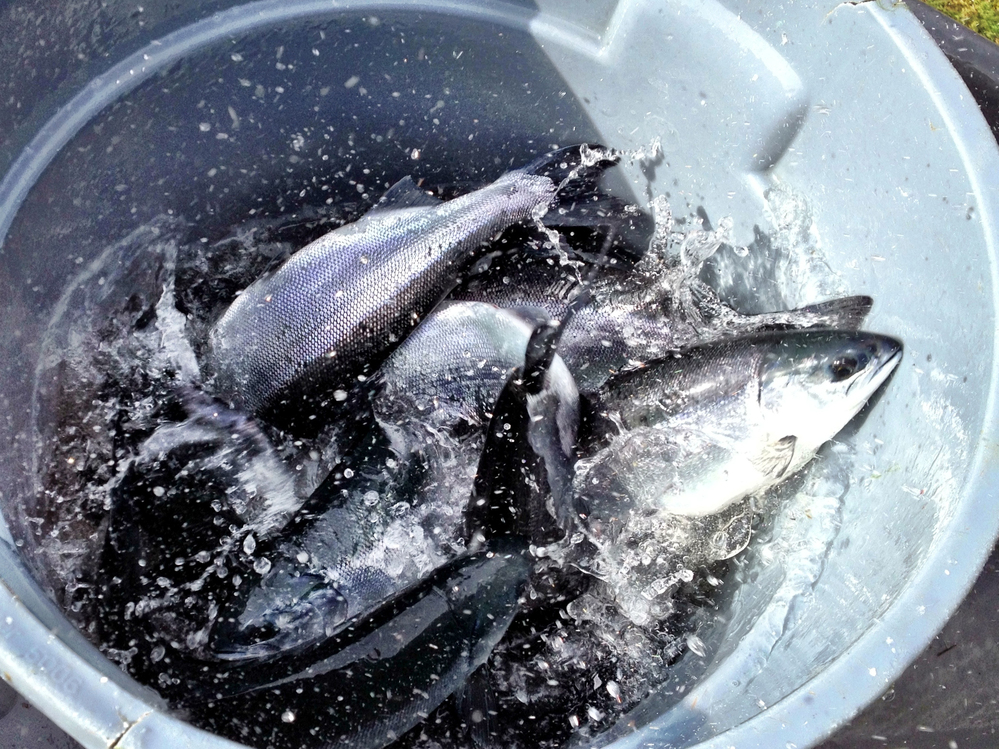
These sockeye salmon were raised at a land-based fish farm in Langley, British Columbia.
Is salmon farming ever sustainable?
For years, many marine biologists have argued that the floating, open-ocean net pens that produce billions of pounds of salmon per year also generate pollution, disease and parasites.
In some places in western Canada, the open-ocean salmon farming industry has been blamed for the collapse of wild salmon populations in the early 2000s though other research has challenged that claim.
But now, a few salmon farms have moved inland, producing fish in land-locked cement basins separated from river and sea. One land-based fish farm in West Virginia has been commended as a sustainable alternative to conventionally produced salmon. On Vancouver Island, there is at least one such facility. And just last month, Willowfield Enterprises, based in Langley, British Columbia, harvested its first inland-farmed sockeye salmon, to be marketed under the brand name West Creek. Sockeye is a Pacific species that has rarely been cultivated before.
"In terms of environmental sustainability, I think [these closed-system farms are] a huge step forward," says Martin Krkosek, an assistant professor at the University of Toronto who has been among the leading critics of ocean net pen salmon production. "Waste material, disease, pollution, parasites all these things aren't a concern with most closed-system aquaculture."
Some forms of aquaculture may have the potential to help ecosystems by taking fishing pressure off of wild fish stocks. But this hasn't been the case with the salmon farming industry, argues Daniel Pauly, a professor of fisheries at the University of British Columbia. One reason why, Pauly tells The Salt, is that the food that salmon farmers feed to their fish is usually fish meal made from wild sometimes overfished species. He points out that humans could be eating these species instead of farmed salmon.
 Enlarge image i
 A view of one of Willowfield's land-locked sockeye tanks.
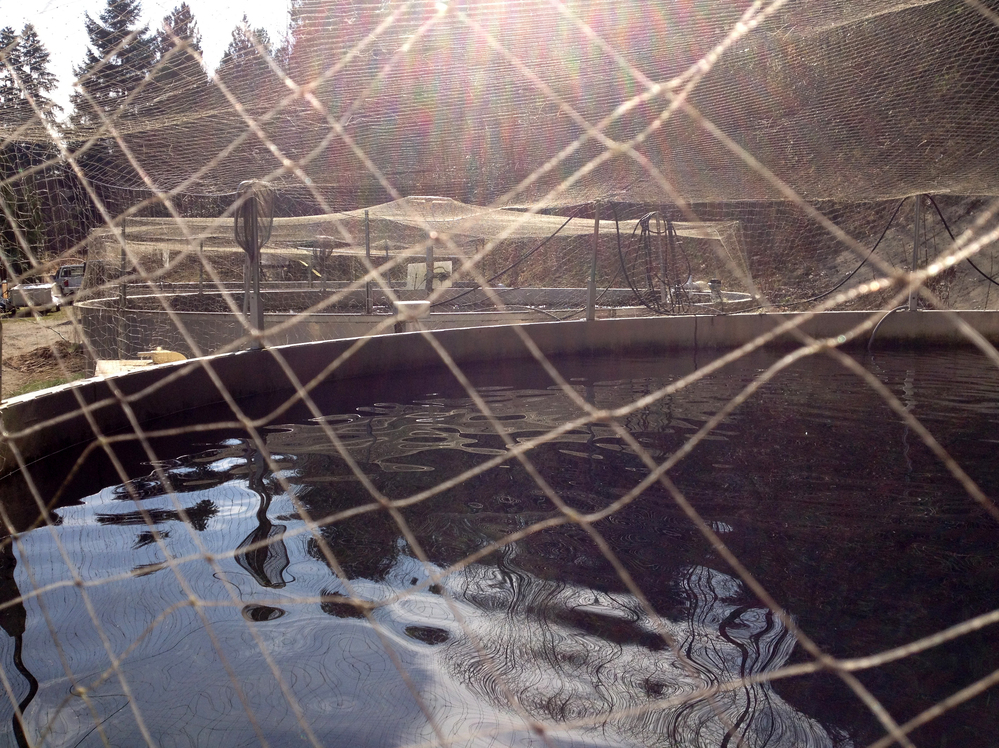
A view of one of Willowfield's land-locked sockeye tanks.
Open-ocean salmon farms can also generate high densities of organic and inorganic waste material which can cause toxic marine algae blooms and create low-oxygen "dead zones." Residues from antibiotics and other chemical treatments can also drift from the pens.
And then there's sea lice. These pea-sized copepods cling to free-moving fish, and under natural circumstances, they aren't usually a threat to salmon. But when many thousands of adult salmon swarm together in crowded net pens, sea lice populations often boom. When juvenile salmon exiting the rivers of their birth pass near such infested pens, the smolts may be swarmed by the parasites and quickly killed. By this process, salmon farms have caused entire runs of wild fish to nearly disappear from streams in the Vancouver Island area, according to Krkosek's research.
The Monterey Bay Aquarium's Seafood Watch program advises consumers to avoid farmed salmon in general, but it makes a specific exception for farmed salmon from contained systems, which the aquarium recommends, according to spokesperson Alison Barratt.
Likewise, the Vancouver Aquarium's seafood rating program, called Ocean Wise, has not approved as "sustainable" a single open-ocean salmon farm, says Teddie Geach, an Ocean Wise representative in Vancouver. However, Ocean Wise has given West Creek's sockeye salmon a top sustainability grade, based on assessments of several criteria. These include the risk of diseases and parasites spreading from farmed fish to wild, and the risk that farmed fish will escape, which can negatively affect the gene pool of wild fish. And then there's something called the "feed conversion ratio," a measure of resource efficiency that considers how much food a given fish species requires to produce each pound of marketable product.
"The closer that ratio is to 1 to 1, the better," Geach says. "You don't want a 10-to-1 ratio."
Krkosek says the feed-conversion ratio of farmed salmon "is improving" and several years ago was about 5 to 1. Wild salmon, he says, are probably less efficient at converting food into flesh, since they are not eating an engineered, optimized nutrition formula, and because they expend great amounts of energy that farmed salmon do not.
Inland aquaculture facilities may be a more environmentally sound way to farm salmon than their open-ocean counterparts. But Krkosek says it's not yet clear whether it would be feasible for the entire salmon farming industry which produced 5 billion pounds of fish in 2012 to make the move. He says "new environmental problems" would likely arise "probably mostly associated with energy and water consumption."
Krkosek also notes that right now, the economics favor cheaper, conventionally farmed salmon.
"In the open-ocean pens, they get clean water and waste disposal for free," he says, adding, "Everyone's waiting to see if the economics work out. But currently, the common refrain in the salmon farming industry [about inland farms] is, 'It's too expensive.' "
Willowfield Enterprises President Don Read, who is farming the West Creek sockeye with partner Lawrence Albright, says his fish sells for about double the price of conventionally farmed salmon and for about 20 percent more than wild sockeye.
"We can't compete with open-ocean aquaculture, but that's today, and maybe we'll get there," Read says. "For now, our fish will be a niche player in the salmon industry."
American Feast's Sustainable Food Blog - Timely food news, fun ... American Feast's Sustainable Food Blog Learn more about natural & organic foods, sustainable food, your health and our planet at the American Feast Blog Mark's Daily Apple Is there a sight more idyllic, peaceful, and touching than that of a fish farmer tending to his flock? In case you arent aware of how fish farming works, heres ... Aquabounty, GMO Salmon Company, Struggling To Stay Afloat WASHINGTON Salmon that's been genetically modified to grow twice as fast as normal could soon show up on your dinner plate. That is, if the company ... Use technology to simplify your life and become a modern day ... Learn how to live as a modern day pioneer and get back to basics, becoming more self sufficient with the assistance of todays technology. Sustainability - Wikipedia, the free encyclopedia Sustainability is the capacity to endure. In ecology the word describes how biological systems remain diverse and productive over time. Long-lived and healthy ... Sustainable Seafood: Wild Caught? Farm Raised? How To Choose Questions around eating fish are a legitimate source of angst. Not only are our oceans in peril from pollution and irresponsible harvesting (according to ... How a Steelhead Trout Goes from the Hoh River to the Entree Menu ... Tracing a steelhead on its journey to the plate from the sea. Ran Prieur Ran Prieur "The bigger you build the bonfire, the more darkness is revealed." - Terence McKenna What You Can Grow in a Portable Farm There have been over 300 different plants that have been tested that will grow in aquaponics systems including tomatoes, lettuces basil, peppers and more. What do you want to know about AquAdvantage Salmon? Biology ... The AquAdvantage salmon has captured the attention of the news, politicians, scientists, and activists, and now you have a chance to learn more about it directly ...

 Enlarge image i